Compound Ecosystem™
The Future of Connected Systems & Compounding Growth
The world is entering a new era of economic transformation.
For decades, businesses have operated through fragmented systems, isolated services, disconnected workflows, and independent operational structures. Companies built departments separately. Technologies evolved independently. Service providers worked in silos. Execution depended heavily on manual coordination, fragmented intelligence, and disconnected infrastructures.
This fragmentation created inefficiency at every level:
- duplicated effort,
- slow execution,
- operational gaps,
- weak scalability,
- disconnected decision-making,
- and limited long-term compounding.
The next generation of growth will not be built through isolated systems.
It will be built through interconnected ecosystems.
This is where the concept of the Compound Ecosystem™ emerges.
What is a Compound Ecosystem™?
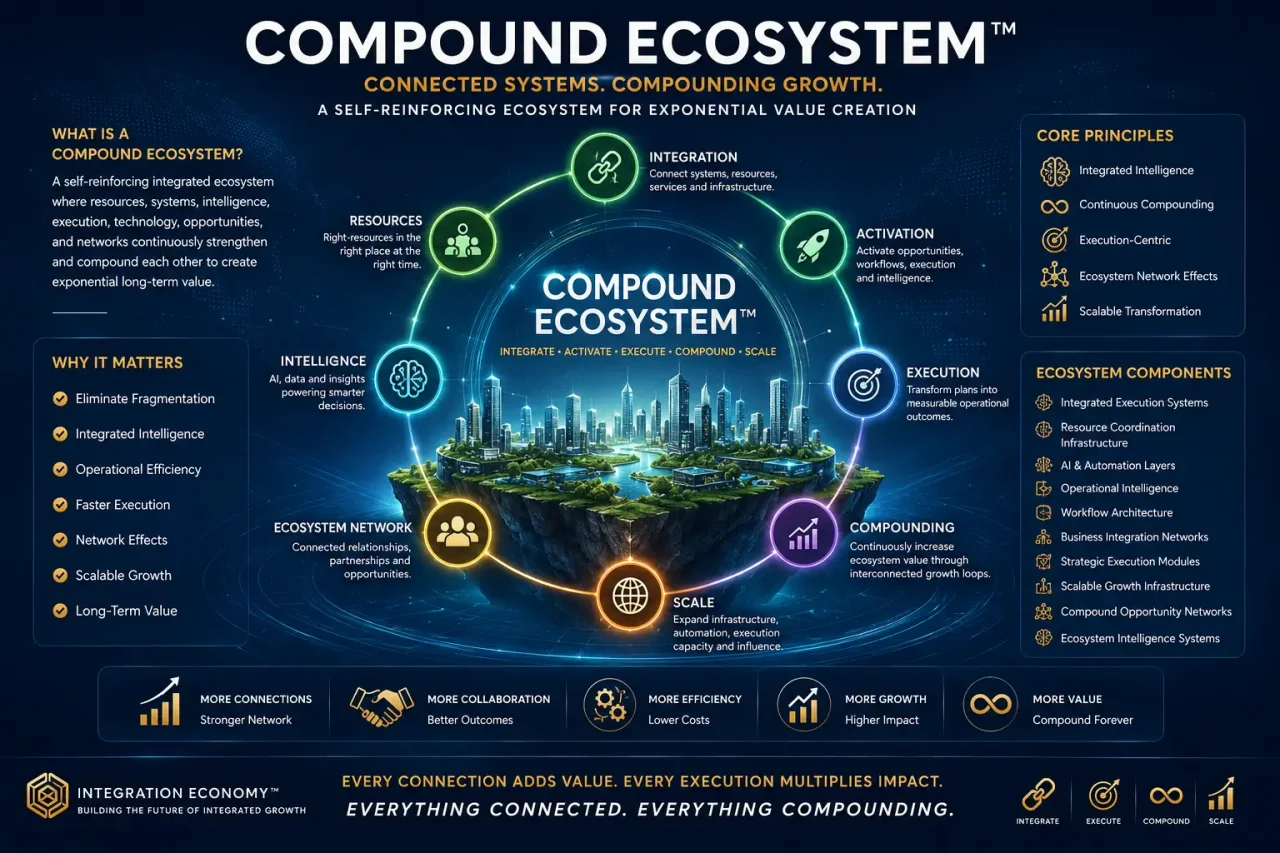
A Compound Ecosystem™ is a self-reinforcing integrated ecosystem where systems, resources, execution, intelligence, infrastructure, opportunities, technologies, and relationships continuously strengthen and compound each other to create scalable long-term value.
Unlike traditional business models where individual activities operate independently, a Compound Ecosystem creates interconnected value loops where every execution increases the strength of the entire ecosystem.
In simple terms:
Every connection adds value.
Every execution multiplies impact.
From Linear Growth to Compound Growth
Traditional organizations operate on linear growth models.
Traditional Linear Structure
- More clients require more manual effort.
- More operations create more complexity.
- More services increase operational burden.
- Scaling becomes expensive and inefficient.
Growth remains dependent on constant resource expansion.
But Compound Ecosystems work differently.
Compound Ecosystem Structure
Every:
- workflow,
- automation,
- client relationship,
- execution process,
- knowledge asset,
- strategic partnership,
- technology integration,
- and operational framework
becomes a reusable infrastructure layer that continuously compounds ecosystem value.
This transforms growth from:
Linear → Exponential
Why Traditional Systems Struggle
Most organizations today suffer from fragmentation.
Fragmented Operations
Departments operate independently with weak coordination.
Disconnected Services
Vendors and service providers work without integrated execution systems.
Isolated Intelligence
Knowledge remains trapped within silos instead of becoming ecosystem intelligence.
Manual Coordination
Execution depends heavily on human coordination across disconnected systems.
Limited Scalability
Operational complexity increases faster than growth.
As organizations scale, fragmentation becomes a major bottleneck.
The Compound Ecosystem Solution
Compound Ecosystems solve fragmentation through integration.
Instead of isolated systems, they create:
- connected infrastructure,
- integrated execution,
- shared intelligence,
- automated coordination,
- scalable workflows,
- and compounding operational value.
Every component strengthens every other component.
The Core Architecture of a Compound Ecosystem™
1. Integrated Systems
Technology, operations, workflows, and execution systems operate through unified infrastructure.
2. Resource Networks
People, services, expertise, partnerships, and opportunities are interconnected through ecosystem coordination.
3. Execution Infrastructure
The ecosystem focuses not only on planning but on scalable real-world execution.
4. Operational Intelligence
Data, automation, AI systems, and execution insights continuously improve ecosystem performance.
5. Compound Value Loops
Every execution creates reusable value that strengthens future operations.
The Power of Ecosystem Compounding
The true strength of a Compound Ecosystem comes from compounding effects.
A New Client
Creates:
- additional opportunities,
- data intelligence,
- referrals,
- partnerships,
- reusable systems,
- and stronger market positioning.
A New Workflow
Improves:
- operational efficiency,
- execution speed,
- automation capability,
- and scalability.
A New Integration
Expands:
- ecosystem reach,
- infrastructure capability,
- intelligence layers,
- and network effects.
Over time, the ecosystem becomes exponentially stronger.
Compound Ecosystem vs Traditional Business Models
| Traditional Model | Compound Ecosystem |
|---|---|
| Isolated operations | Integrated infrastructure |
| Linear growth | Compounding growth |
| Manual coordination | Intelligent coordination |
| Service-based structure | Ecosystem-based structure |
| Independent workflows | Connected execution systems |
| Limited scalability | Scalable infrastructure |
| Short-term transactions | Long-term ecosystem value |
The Rise of the Integration Economy™
The global economy is evolving toward interconnected infrastructure models.
The future will increasingly depend on:
- integrated execution,
- ecosystem intelligence,
- automation,
- network effects,
- and scalable coordination systems.
This broader transformation is known as the Integration Economy™.
Within this emerging economic framework:
- Integrated Execution Ecosystems provide operational infrastructure,
- Ecosystem Networks create connected opportunity layers,
- and Compound Ecosystems become the compounding growth engine.
Industries Moving Toward Compound Ecosystems
The Compound Ecosystem model is becoming relevant across:
- business infrastructure,
- technology platforms,
- AI ecosystems,
- financial systems,
- logistics networks,
- healthcare infrastructure,
- education systems,
- professional services,
- industrial operations,
- and digital transformation ecosystems.
Organizations that integrate systems effectively will outperform those operating in fragmentation.
The Role of AI & Automation
Artificial intelligence significantly accelerates the power of Compound Ecosystems.
AI enables:
- intelligent coordination,
- predictive execution,
- workflow automation,
- operational optimization,
- scalable intelligence systems,
- and ecosystem-level decision support.
When AI combines with integrated infrastructure, ecosystem compounding accelerates dramatically.
The Future is Ecosystem-Driven
The next generation of global organizations will not operate as isolated entities.
They will function as:
- interconnected ecosystems,
- intelligent execution networks,
- integrated infrastructure platforms,
- and compound growth systems.
The organizations that master integration, coordination, and execution compounding will define the future economic landscape.
Final Vision
The Compound Ecosystem™ is more than a business model.
It is a next-generation infrastructure philosophy for scalable growth, integrated execution, operational intelligence, and ecosystem-driven transformation.
It represents the shift from:
- fragmentation to integration,
- isolated operations to connected systems,
- linear execution to compounding growth,
- and traditional organizations to intelligent ecosystems.